At Not Quite Right, we pride ourselves in fostering and featuring a wide variety of themes, voices, and personalities across prose and poetry. In this feature poetry spotlight on the Not Quite Right blog, we’re spending some time with Poet MJ Weerts, dissecting some of his life and poetry.
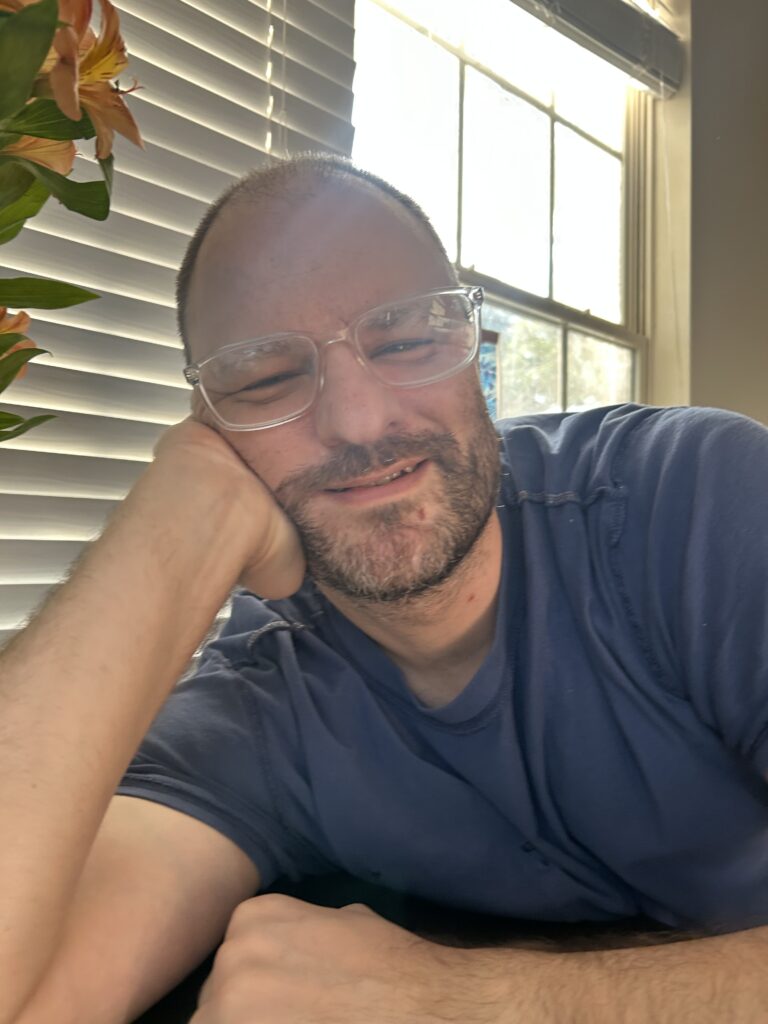
About MJ Weerts
MJ Weerts teaches composition and literature at Louisiana State University (LSU). He received an MFA in Creative Writing (Poetry) from Minnesota State – Mankato in 2010, and an MFA in Screenwriting from UCLA in 2022.
His poetry can also be found in the Stone Circle Review: https://stonecirclereview.com/a-tree-in/
Editorial Introduction from Not Quite Right
We are honored to feature four compact, strange, and sharply-attuned poems by MJ Weerts. Across these pieces, the ordinary world tilts just enough to reveal something sort of mythic, absurd, or wounded beneath it. A plate of cookies becomes an invitation to invent origin stories. A sports bet brushes against grief, noise, and spiritual freefall. A preschool classroom holds the invisible strain of a final day. A row of fenceposts opens into landscape, absence, and art.
What makes these poems so compelling is their restraint. They do not over-explain themselves or soften their oddness for the reader. Instead, they trust image, compression, and emotional pressure. This is what makes them feel right at home here at Not Quite Right. Each poem feels like a small door left open, offering just enough light to make us curious about what happened before, and what happens after. These are poems that understand how much can happen in a sentence, a gesture, a fracture in the expected order of things.
Poetry
Birth of the hop
She puts cookies and a list out
on a night that is not a winter
holiday. Ants are all she gets
until a voice asks her to write
a myth on the origin of
unwritten mail delivery.
go green
When the parlay was one replay away,
she spoke to a friend who’d died alone
in the snow. The bet was a push but
that same night she woke to her gf’s
new green noise app and gave herself
to Wicca for good.
She’s thru with your in-app chats
The parents have no idea today
is her last in the Pre-K, but one
look up on drop-off and they’d
see a jaw full of muscles whose
flex was about to give out.
Escape route
A single line of fenceposts gave way
to air at the property edges, and didn’t
come back for the frame, leaving the
canyon they backstopped free. A local
artist elbowed two posts in the center.
Critical Commentary from Not Quite Right
Why These Poems Stayed With Us
What first stands out about these poems is their compression. Each one arrives quickly, almost quietly, and then leaves behind more than its size should be able to hold. These are very brief poems, but they are not slight. They work through implication, pressure, and juxtaposition. Instead of explaining their emotional worlds, they place us inside moments that feel already charged, already strange, already close to breaking open.
Across all four pieces, the ordinary is never merely ordinary. In “Birth of the hop,” a small domestic ritual, cookies and a list left out on a night “that is not a winter / holiday,” becomes the beginning of a private mythology. The poem borrows the shape of familiar childhood belief, then turns it sideways. There is anticipation, offering, disappointment, and then a voice that asks for invention. What begins as a scene of almost comic misalignment, ants arriving where magic might have been expected, becomes a poem about authorship itself. The “origin of / unwritten mail delivery” suggests a mythology for messages that never arrive, stories that have not yet been sent, and systems of belief built around absence.
“go green” moves with a similar strangeness, but its emotional field is darker and more volatile. The poem brings together gambling language, death, weather, technology, intimacy, and religious conversion in only a handful of lines. A “parlay” being “one replay away” sits beside the memory of a friend who “died alone / in the snow,” and the casual vocabulary of sports betting suddenly becomes inseparable from grief, chance, and the terrible randomness of survival. The ending, with the speaker waking to her girlfriend’s “new green noise app” and giving herself “to Wicca for good,” is both funny and deeply serious. The poem refuses to separate absurdity from spiritual need. It recognizes that people often find belief not through grand revelation, but through accumulation, through noise, through loss, through the odd timing of ordinary things.
“She’s thru with your in-app chats” is perhaps the most quietly devastating of the group. Its title is wry, contemporary, and almost dismissive, but the body of the poem turns toward emotional strain with remarkable restraint. The parents “have no idea” that this is her last day in the Pre-K, and the poem asks us to notice what they do not: “a jaw full of muscles whose / flex was about to give out.” That image is especially powerful because it avoids melodrama. We are not told exactly what has happened, what resignation has been submitted, what exhaustion has accumulated, or what institutional failure might be implied. We are only shown the body carrying what language has not yet released. The jaw becomes the site of labor, restraint, anger, professionalism, and collapse. In a poem this small, that image does enormous work.
“Escape route” opens outward, away from the intimate interiors of the previous poems, but it remains interested in borders, gaps, and the strange agency of what is missing. A line of fenceposts “gave way / to air at the property edges,” and the canyon they once “backstopped” is suddenly “free.” The poem’s landscape feels both literal and metaphysical. Boundaries fail. Frames do not hold. Something that was contained, marked, or visually controlled becomes open again. Then, in the final sentence, a local artist intervenes, placing “two posts in the center.” That gesture complicates the freedom of the canyon. Is the artist restoring a boundary, commemorating one, parodying one, or turning the remnants of enclosure into art? The poem does not settle the question, which is part of its strength. It leaves us with a small, haunting act of arrangement.
Taken together, these poems feel deeply aligned with the spirit of Not Quite Right. They are off-kilter in the best sense. They do not announce their meanings cleanly, and they do not behave as if poetry’s job is to resolve experience into neat revelation. Instead, they honor the unfinished, the inexplicable, the slightly absurd, and the emotionally true. Their speakers and figures seem to live at the edge of systems: holiday rituals, gambling logic, workplace communication, property lines, spiritual belonging. In each poem, a structure that should organize the world either fails, bends, or becomes strange.
That is where much of the energy of the work resides. These poems are interested in what happens when familiar frameworks stop functioning. A holiday ritual produces ants instead of magic. A bet becomes tangled with mourning. An app-adjacent modern life gives way to older forms of belief. A classroom drop-off becomes the site of invisible departure. A fence fails to define the land it was meant to contain. Again and again, the poems ask us to look at the edges of ordinary life and notice where meaning leaks through.
They are also formally confident. Their brevity requires trust, and the poems have that trust. They trust the reader to sit with gaps. They trust that a single image can carry emotional consequence. They trust that humor and grief can occupy the same room without cancelling each other out. The result is a set of poems that feel deceptively small at first glance, then increasingly resonant the longer we stay with them.
What we admire most is the way these poems make room for mystery without becoming vague. They are strange, yes, but their strangeness is precise. The cookies, the ants, the replay, the snow, the green noise app, the jaw muscles, the fenceposts, the canyon, each image feels chosen, concrete, and alive. These poems do not ask us to understand everything. They ask us to pay attention. And in that attention, something opens.
A Conversation with MJ
To get to know MJ and his poetry just a little bit better, we asked him a few questions about his style, experience, and writing process.
Nicky Bennett: These poems are very brief, but they feel like they open into much larger stories. How do you know when a poem is finished at this size?
MJ Weerts: I’ve written so much through the years that was just objectively unsuccessful: novels, plays, screenplays. If I can flex about anything as a writer, it’s not the number of rejections, but the breadth of them. What I finally started to see, just in the last year, was that what interest me most was creating the world. So I make it, and then get out of there as quickly as possible!
NB: A lot of these pieces begin in ordinary, recognizable situations, then tilt into something stranger. What draws you to that shift between the everyday and the uncanny?
MJ: I’m well-medicated now, but I was institutionalized for my whole 23rd and 24th years (in a drug treatment center, and later a halfway house for veterans). I then worked at that same place as live-in staff for a year after that. One great thing about that time was that I met people who were very different. I’m still active in multi-stream recoveries, just to make sure I’m leaning into the good and staying away from being an asshole. I don’t think I assume anymore that the world I’m living in is the same one anyone else is living in. It’s a fund surprise when we understand each other.
NB: How important are titles in your work? In these poems especially, the titles seem to do a lot of shaping before the first line even begins.
MJ: Oh God, so important. They help me get in and out, as I mentioned. Like everyone else, I’m looking for a good marriage of abstraction and concrete image. So if the poem is too specific, I can add something really abstract and broad to the title, or vice versa, to kind of bring that pH balance into a place where it’s not milk or acid, but like a green juice.
NB: Do your poems usually begin with an image, a sentence, a feeling, a joke, a dream, or something else entirely?
MJ: I almost exclusively begin by setting things up. Exposition. I want people to know exactly what’s going on and then expand or shrink or spin from there. I think it’s because I started as a playwright. Shout out to Charles Smith at Ohio University, who taught me that. I pushed back on it, but he was right, of course.
NB: What writers, artists, books, or other influences have shaped the way you approach poetry?
MJ: My writing has always fallen between genres. What’s funny is that I can see all that writing in these very short poems! So hopefully, the ideas have found a home, in the same way that I have here in Louisiana at LSU, which I love, and with Thao and Kai, whom I love so much.
My favorite poets are Kay Ryan and Emily Dickinson. I also love Zadie Smith, Annie Baker, Emil Cioran, Lydia Davis, Huang Po, Olga Tokarczuk, and Phyllis Nagy.
Closing Note
Our thanks to MJ Weerts for trusting Not Quite Right with these four poems, and for giving our readers work that refuses to flatten itself into easy meaning. These poems linger because they leave room. Room for uncertainty, room for unease, room for the odd little truths that surface when the world tilts just slightly out of place.